2,410 result(s)
Page 1
of 241
RPP
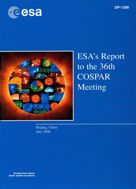
Series ESA's report to the 36th COSPAR meeting . 2006, July, Beijing, China
added 07/09/2026
updated 07/09/2026
| Identifier | ESA_SP_1296 |
| Title | ESA's report to the 36th COSPAR meeting . 2006, July, Beijing, China |
| Author | ESA |
| Subject | COSPARESAScience programmeScience missionsHSTHubbleUlyssesSOHOCASSINIXMMRosettaOperations |
| Date | Jul-06 |
| Description | The report for the 36th COSPAR Meeting covers, as in previous issues, the missions of the Scientific Programme of ESA in the areas of astronomy, Solar System science and fundamental physics. This year’s COSPAR meeting will take place only weeks before the end of the SMART-1 mission to the Moon, a technology project that provided the first European look at our natural satellite from lunar orbit. In December 2006, a new mission was launched: COROT. ESA, together with a number of countries, contributed to this unique, French-led project that provides an insight into the interior of the stars, by means of the asteroseismology technique successfully applied by SOHO. The record number of ESA Science Programme missions in operation established at the time of the last report was maintained in 2006 (Huygens having been replaced in the list by Venus Express). Eleven different missions, involving 14 operating spacecraft, are providing excellent science to the worldwide scientific community. |
| Publisher | ESA-ECSR |
| Contributor | Pierre Kirchner (archive manager), ECSR team |
| Type | Text |
| Format | Medium: Paper |
| Source | SUN:Box0010 |
| Language | en |
| Rights | ESA |
Series Recommendations on the Development of Space Science in the 1980s

added 29/05/2026
updated 29/05/2026
| Identifier | ESA_SP_1015 |
| Title | Recommendations on the Development of Space Science in the 1980s |
| Author | ESA, ESA Scientific and Technical Publications Branch. |
| Subject | Publicationsspecial PublicationsSPScience programmeSpacelabAriane |
| Date | 01/12/1978 |
| Description | The reflections and recommendations presented in this report are the result of work begun within ESA since 1975, with the aim of developing the first long-term policy programme for the Agency's scientific activities. Avoiding the selection of future scientific projects, the report focuses on an analysis of the role of space research in Europe over the next decade, taking into account the needs of the scientific community and the overall forecasts that can be made now for the development of space activities in general. After a critical review of the past role of ESA and its effectiveness in the field of science, the Scientific Advisory Committee reflects on the development of space science during the 1980s, proposes methods for implementing its recommendations and indicates directions for the use of the Agency's current and future technical resources. |
| Publisher | ESA-ECSR |
| Contributor | Pierre Kirchner (archive manager), ECSR team |
| Type | Text |
| Format | Medium: application/pdf |
| Language | en, fr |
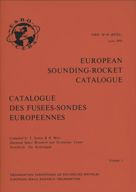
Series Catalogue des Fusées Sondes
added 04/03/2026
updated 04/03/2026
| Identifier | ESRO_SP_39_FR |
| Title | Catalogue des Fusées Sondes
European Sounding Rocket Catalogue - Volume I |
| Author | ESRO |
| Subject | ESROSpecial PublicationsSounding RocketIndustry |
| Date | 01/06/1970 |
| Description | The present directory of sounding rockets does not aim to present a complete monographic study for each vector. Its purpose is to summarise information on existing or planned European vehicles in standard form. This catalogue also allows an easy but not detailed comparison of the essential characteristics and performance of the machines available or under development. - A questionnaire was drawn up based on the replies to which had been sent to European industry interested in, or likely to make, vehicles. A sounding rocket is considered to be "European" if it is manufactured by one of the ten member countries of ESRO (Belgium, Denmark, Spain, France, Italy, the Netherlands, Germany, Sweden, Switzerland, the United Kingdom). |
| Publisher | ESA-ECSR |
| Contributor | ECSR team |
| Type | Text |
| Format | Medium: application/pdf |
| Source | SUN:Box0001 |
| Language | en, fr |
| Rights | ESA |
Series Images of the Nucleus of Comet Halley obtained by the Halley Multicolour Camera (HMC) on board the Giotto spacecraft

added 04/03/2026
updated 04/03/2026
| Identifier | ESA_SP_1127_VOL_1 |
| Title | Images of the Nucleus of Comet Halley obtained by the Halley Multicolour Camera (HMC) on board the Giotto spacecraft |
| Author | Max-Planck-Instiut für Aeronomie, European Space Agency, R. Reinhard, N. Longdon, B. Battrick |
| Subject | Publicationsspecial PublicationsSPScience programmeGiottoHalleyCometEncounterHMCNucleus |
| Date | 1986-1994 |
| Description | N.T. Bobrovnikoff's work on ‘Halley’s Comet in its Apparition of 1909—1911’, published in 1931, may be considered the first ‘Atlas of Comet Halley‘, displaying about 50 of the best (qualitatively) photographs obtained during that apparition. A much more complete collection of the photographs obtained during that apparition is included in the first proper ‘Atlas of Comet Halley 1910 II‘ by B. Donn, J. Rahe and JC. Brandt, published in 1986. Volume 1 of this Atlas includes all important images of the nucleus of Halley’s comet obtained by the Halley Multicolour Camera (HMC) on board ESA’s Giotto Spacecraft. |
| Publisher | ESA-ECSR |
| Contributor | ECSR team |
| Type | Text |
| Format | Medium: paper |
| Language | en |
| Rights | For images:Max-Planck-Institut fùr Aeronomie, For publication:ESA |
Series Rapport du Groupe de Travail Scientifique et Technique
added 10/02/2026
updated 10/02/2026
| Identifier | RAPPORT_GTST_FR |
| Title | Rapport du Groupe de Travail Scientifique et Technique |
| Author | COPERS |
| Subject | COPERSESROBlue BookStrategyScience programme |
| Date | 1961 |
| Description | Report presented during the 3rd Session of the Scientific and Technical Working Group (GTST) of the European Preparatory Commission for Space Research (COPERS) held in Munich, 23-25 October 1961. The document was published after the meeting with a blue cover and renamed as "The Blue Book" giving an overview of the future ESRO programmes, the design of a European Technology Centre and location for vehicles and launching ranges |
| Publisher | ESA-ECSR |
| Contributor | Pierre Kirchner (archive manager), ECSR Team, HAEU |
| Type | Text |
| Format | Medium: pdf |
| Source | HAEU |
| Language | fr |
Series Encounter operations manual - Giotto Comet Halley

added 28/01/2026
updated 28/01/2026
| Identifier | GIOTTO_ENCOUNTER_MANUAL |
| Title | Encounter operations manual - Giotto Comet Halley |
| Author | ESA-ESTEC |
| Subject | Science programmeGiottoComet HalleyEncountherOperation |
| Date | 10/02/1986 |
| Description | This document has been produced to give visiting scientists and their operations personnel an overview of the activities during the GIOTTO Encounter period 10 - 15 March 1986. In general the arrangements detailed in the document wiii come into force on 10 March 1986. |
| Publisher | ESA-ECSR |
| Contributor | Pierre Kirchner (archive manager), ECSR team |
| Type | Text |
| Format | Medium: paper
Medium: pdf |
| Language | en |
Series Report of the Scientific and Technical Working Group

added 28/01/2026
updated 28/01/2026
| Identifier | COPERS_GTST_23_EN |
| Title | Report of the Scientific and Technical Working Group |
| Author | COPERS |
| Subject | COPERSESROBlue BookStrategyScience programme |
| Date | 1961 |
| Description | Report presented during the 3rd Session of the Scientific and Technical Working Group (GTST) of the European Preparatory Commission for Space Research (COPERS) held in Munich, 23-25 October 1961. The document was published after the meeting with a blue cover and renamed as "The Blue Book" giving an overview of the future ESRO programmes, the design of a European Technology Centre and location for vehicles and launching ranges |
| Publisher | ESA-ECSR |
| Contributor | Pierre Kirchner (archive manager), ECSR Team, HAEU |
| Type | Text |
| Format | Medium: microform
Medium: pdf |
| Source | microfiche |
| Language | en |
Series Convention for the Establishment of a European Organisation for the Development and Construction of Space Vehicle Launchers with Protocols

added 28/01/2026
updated 28/01/2026
| Identifier | ELDO_CONVENTION_2 |
| Title | Convention for the Establishment of a European Organisation for the Development and Construction of Space Vehicle Launchers with Protocols |
| Author | ELDO |
| Subject | ELDOConventionActPlenipotentiaries |
| Date | 1962-1968 |
| Description | ELDO Convention issued in London on 29/03/1962 and revised in June 1968. The publication contains: Convention for the Establishment of a European Organisation for the Development and Construction of Space Vehicle Launchers and its Annex referred to in Article 18 of the Convention (List of facilities) and the Annex referred to in Article 19 of the Convention. (Definitions). In addition, it contains the Financial Protocol annexed to the Convention, the Protocol concerning certain responsibilities in connexion with the initial programme, the Protocol and Supplementary Agreement establishing a Preparatory Group, the Protocol of Signature to the Protocol on Privileges and Immunities of the European Launcher Development Organisation, the Protocol on Privileges and Immunities of the European Launcher Development Organisation and the Protocol required by article 8 (1) (e) (ii) of the Convention for the Establishment of a European Organisation for the Development and Construction of Space Vehicle Launchers, Concerning the Use of Technical Information for Purposes not within the Field of Space Technology |
| Publisher | ESA-ECSR |
| Contributor | Pierre Kirchner (archive manager), ECSR team |
| Type | Text |
| Format | Medium: application/pdf |
| Source | SUN:Box0001 |
| Language | en,fr |
Series ELDO/ESRO Journal 1969, Volume 1 N. 1

added 27/01/2026
updated 27/01/2026
| Identifier | ELDO_ESRO_JOURNAL_1969_1_1 |
| Title | ELDO/ESRO Journal 1969, Volume 1 N. 1 |
| Author | ELDO, ESRO |
| Subject | ELDO/ESRO JournalELDO/ESRO Technical Review |
| Date | 1969 |
| Description | The volume contains the following articles: E. Cambi, "The reliability of a space vehicle launcher system"; O. G. Feil, "The magnetic test facilities at ESTEC"; G. E. N. Scoon, "The telemetry station at Monte Cardiga, Sardinia"; M. Fuchs and W. Wienss, "Launch clearance procedure on the basis of wind load precalculations for the Europa I vehicle in Woomera" |
| Publisher | ESA-ECSR |
| Contributor | Pierre Kirchner (archive manager), ECSR Team |
| Type | Text |
| Format | Medium: Hardcopy |
| Source | ELDO/ESRO Journal and ESA STR (1966-1972) |
| Language | en |
Series ELDO/ESRO Journal 1969, Volume 1 N. 2

added 27/01/2026
updated 27/01/2026
| Identifier | ELDO_ESRO_JOURNAL_1969_1_2 |
| Title | ELDO/ESRO Journal 1969, Volume 1 N. 2 |
| Author | ELDO, ESRO |
| Subject | ELDO/ESRO JournalELDO/ESRO Technical Review |
| Date | 1969 |
| Description | The volume contains the following articles: H. Hauck, "Implementation of a digital control unit for a space probe using MOSFETS"; M. Cassou, "Monte Carlo methods: application to the Europa II launcher" (Title translated from French); J. Doenecke, "The conversion of measured heat fluxes into the average radiation incident on curved shapes"; J. C. Liénard, "Phase-controlled mouth: linear phenomena" (Title translated from French); T. D'Amico, "On a property of sampled signals and its application in spectral analysis" (Title translated from French) |
| Publisher | ESA-ECSR |
| Contributor | Pierre Kirchner (archive manager), ECSR Team |
| Type | Text |
| Format | Medium: Hardcopy |
| Source | ELDO/ESRO Journal and ESA STR (1966-1972) |
| Language | en, fr |
2,410 result(s)
Page 1
of 241
RPP


